Is it always personal? Navigating complex friendship dynamics
Nov 21, 2023
Friendship dynamics can be surprisingly confusing. One moment everything feels straightforward and the next you're questioning yourself, wondering whether you've done something wrong or why a particular relationship keeps following the same pattern.
One of the most useful questions I've ever asked someone in conflict is this:
If another person with similar broad-stroke personality traits were in your position, would they be treated the same way?
I asked this recently while talking with a friend who felt exhausted by the dynamics in her friendship group. She described constantly feeling misunderstood and misinterpreted. As someone who values fairness, honesty and kindness, she found it deeply upsetting to keep finding herself cast in a role she didn't recognise.
The situation had become emotionally draining. She was spending increasing amounts of time trying to explain herself, defend herself and understand what she had done wrong.
When I asked the question, she paused.
Then she laughed.
Because the answer was obvious.
Yes.
Another person with similar values, sensitivity and way of relating would probably have found themselves in exactly the same position.
And that changed something.
Not because it solved the problem, but because it loosened the belief that the situation was entirely about her.
When conflict becomes personal
Most of us naturally assume that if a situation keeps happening, there must be something wrong with us.
If we feel criticised, excluded, blamed or misunderstood, we instinctively look for evidence that we caused it.
Sometimes that's appropriate. Self-reflection is important.
But sometimes we end up carrying responsibility for things that belong to other people.
What we experience as a personal attack may actually be someone else acting out a familiar pattern.
Their fears.
Their insecurities.
Their unresolved history.
Their need to feel safe, powerful or supported.
The difficulty is that when we're standing in the middle of the conflict, it rarely feels that way.
It feels personal because we're the one experiencing it.
Why groups sometimes need a villain
Over the years I've noticed that some friendship groups develop patterns that resemble the Karpman Drama Triangle, but not always in the obvious way.
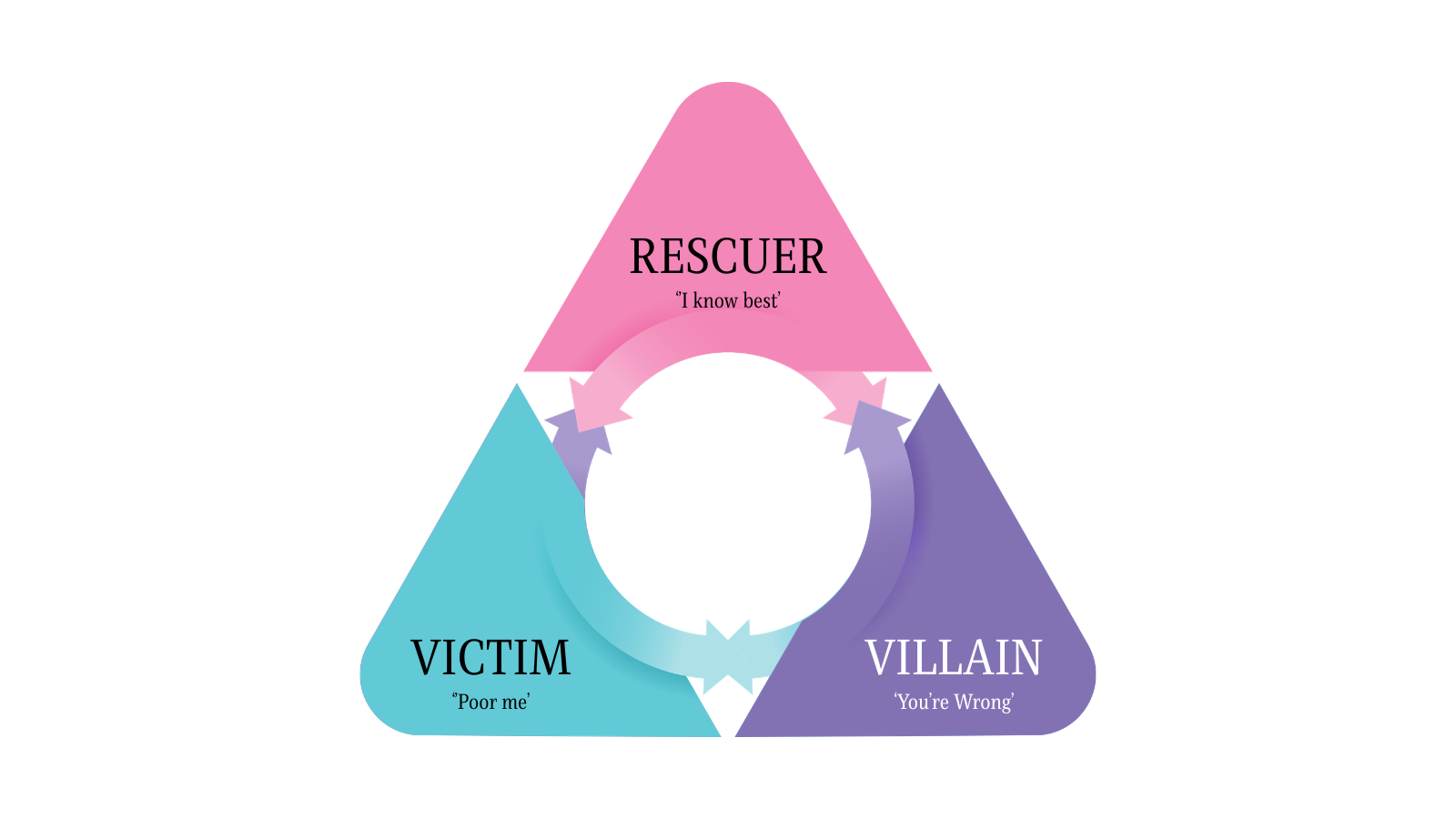
If someone has learned to feel secure by occupying the victim position and gathering rescuers around them, eventually a problem emerges.
Every victim needs a villain.
And if there isn't one available, one may be unconsciously created.
This can leave the chosen 'villain' feeling bewildered.
They find themselves defending against accusations that don't quite fit, trying to prove their intentions, or endlessly explaining their perspective.
The more they explain, the more trapped they often become.
From the outside, the dynamic can be surprisingly predictable.
From the inside, it feels deeply personal.
Looking back through a different lens
This question has helped me make sense of experiences in my own life too.
Looking back at some of the difficult situations I encountered growing up, I can now ask:
If another child with similar traits had been standing where I was standing, would they have received similar treatment?
In many cases, the answer is yes.
That doesn't make the experience acceptable.
It doesn't erase the hurt.
But it does change what the experience means.
The event stops being evidence of something fundamentally wrong with me and becomes evidence of another person's behaviour, limitations or wounds.
This shift of thinking is important.
Because many of us spend years trying to heal the wrong thing.
The work that comes next
Depersonalising an event is not the end of the work.
It's the beginning of it.
Once we've recognised that a situation may not have been entirely about us, a different set of questions becomes available:
Why did this affect me so deeply?
What fear did it touch?
What belief about myself became activated?
What old wound was suddenly back in the room?
What am I still carrying from this experience?
These questions move us away from analysing the other person and back towards understanding ourselves.
Not because everything was our fault.
But because our healing lives there.
Understanding the difference
One of the most important skills we can develop is learning to separate what belongs to us from what belongs to somebody else.
The other person may be working through their own material.
We may be working through ours.
Growth often begins when we stop treating another person's behaviour as a verdict on our worth.
Because when we do that, we become free to ask a different question.
Not:
"What is wrong with me?"
But:
"What is this experience showing me about myself?"
Those are very different questions.
And they lead to very different places.
When Understanding Isn't Quite Enough
Realising that a situation wasn't entirely about you can be incredibly freeing.
But it often raises another question.
If the conflict wasn't really about me, why did it affect me so deeply?
Why did this particular situation trigger such a strong reaction?
Why does something similar keep happening in different relationships?
I've recorded a free guided Root Exploration that helps you explore one subconscious root connected to a recurring pattern in your life.
Bring a conflict, relationship dynamic or situation that still carries an emotional charge, and allow your deeper mind to show you what may lie beneath it.
Sometimes the conflict isn't the root.
It's simply the thing that led you to it.
